University of California Press

About the Book

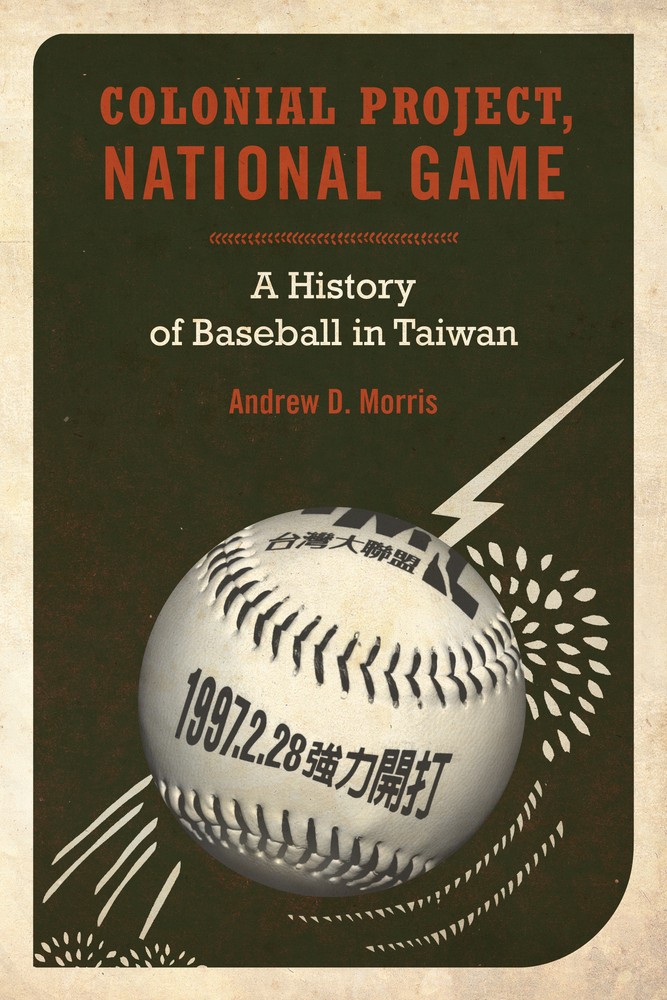
In this engrossing cultural history of baseball in Taiwan, Andrew D. Morris traces the game’s social, ethnic, political, and cultural significance since its introduction on the island more than one hundred years ago. Introduced by the Japanese colonial government at the turn of the century, baseball was expected to “civilize” and modernize Taiwan’s Han Chinese and Austronesian Aborigine populations. After World War II, the game was tolerated as a remnant of Japanese culture and then strategically employed by the ruling Chinese Nationalist Party (KMT) Even as it was also enthroned by Taiwanese politicians, cultural producers, and citizens as their national game. In considering baseball’s cultural and historical implications, Morris deftly addresses a number of societal themes crucial to understanding modern Taiwan, the question of Chinese “reunification,” and East Asia as a whole.

About the Author

Andrew D. Morris is Professor of History and Chair of the History Department at California Polytechnic State University, San Luis Obispo. He is the author of Marrow of the Nation: A History of Sport and Physical Culture in Republican China (UC Press) and coeditor of The Minor Arts of Daily Life: Popular Culture in Taiwan.

Table of Contents

Acknowledgments
Map of Taiwan

Introduction

1. Baseball in Japanese Taiwan, 1895–1920s
2. Making Racial Harmony in Taiwan Baseball, 1931–1945
3. Early Nationalist Rule, 1945–1967: “There’s no Mandarin in baseball”
4. Team of Taiwan, Long Live the Republic of China: Youth Baseball in Taiwan, 1968–1969
5. “Chinese” Baseball and Its Discontents, 1970s–1980s
6. Homu-Ran Batta: Professional Baseball in Taiwan, 1990–Present
7. Conclusion: Baseball’s Second Century in Taiwan

Appendix: Taiwanese Professional Baseball Teams and National Origin of Foreign Players

Notes
Glossary of Chinese, Japanese, and Taiwanese Terms and Names
Selected Bibliography
Index
Photographs follow page

Reviews

“An excellent read and a must study for anyone wishing to understand baseball in a global setting. . . . Highly recommended.”
Choice
“Morris offers an innovative reading of history.”
China Review International
“Captivating prose. . . . A much-needed view from the margins.”
Pacific Affairs, Ubc
“Beautifully written.“
American Historical Review
“Morris’s nuanced account of the history of baseball in Taiwan is an enjoyable read. It is a major contribution, not only to the field of baseball and sports history in Asia, but also to the history of modern Taiwan.”
The China Journal
“Offers indispensable elements of knowledge and analyses to those intending to include baseball in their future studies of Taiwan.”
China Perspectives
"Engaging and well-written . . . a major contribution."
Journal of Global History
"Morris successfully weaves the intricacies of baseball's history into a compelling narrative while giving us a keen analysis of its larger significance. It is rare to find someone who can pull that off. This is an absorbing and distinguished addition to sports history, to Taiwanese history, and to studies of colonialism and its aftermath."—William Kelly, Yale University

"Colonial Project, National Game offers an engaging and penetrating analysis of the culture of baseball in Taiwan, in both its local and global conditions. Morris weaves details into a compelling narrative that is as much about the game on the field as the game being played out in the arenas of ethnicity, nationalism and geopolitics. Morris's study is a model of sophistication and lucidity. He demonstrates that through a perceptive reading of the mundane world of curve balls and player contracts, we can better understand the ideological substructure of the social."—Joseph R. Allen, University of Minnesota, Twin Cities